Columbia Classical Fencing, LLC, will soon start studying la canne, or cane fencing as it was practiced in the French salles in the 19th century. For the benefit of CCF’s members and whoever else may be interested, I’m posting here a historical summary to better understand the context in which la canne arose. At the bottom, you’ll see some links that I have found both interesting and useful.
La Canne and the French Revolution
Martial cane use was taught before the French Revolution, but, as far as I can tell, it was not systematized at the time in France. There were German and Italian Renaissance treatises that addressed fighting with staves and bladed poles, but these do not seem to have closely informed French la canne as it developed in the 19th century.
Historically, the cane—usually made of olive—was a humble instrument, traditionally associated with the peasant’s or provincial’s walking stick used in the countryside (likewise, the bâton is itself a French weapon, derived from the medieval staff).
Comparatively, the aristocracy had always been associated with the sword. The French aristocracy was originally recognized as the noblesse d’épée (that is, the nobility of the sword). This title recognized the aristocracy’s historical role as the defenders of the realm, the knights the French king would call upon to protect the region from invaders. Notably, the French academies (i.e., the private boarding schools for the aristocracy that flourished in the 17th and 18th centuries) taught young noblemen fencing with a sword, not sticks.
But, during and after the Revolution, the cane became a symbol for—and, indeed, instrument of—the people’s power. (That’s not to say that the sans culottes eschewed bladed arms. They were often pictured carrying a saber as well as a revolutionary readiness to use it.) By this time, its potential as a weapon was on the rise.
After the Napoleonic Wars
Even with the end Napoleonic Wars, there was still more turmoil for France in remaining years of the century. Even putting aside the ensuing revolutions and oscillations from empires to republics, France faced the growing pains the accompanied the nascent Industrial Revolution. For instance, capitalists demanded labor resulting in an influx of urban immigration, both from the countryside and from other countries. At the same time, railways spread across France, with Paris as the hub.
Given the new mobility across the country and the industrialists’ demand for workers, France’s capital itself doubled in size in the first half of the nineteenth century. Paris’s slums swelled with poor laborers, many of who were uneducated or did not speak French very well.
Worse, by the mid-1800s, France was again in an economic crisis: scarce agricultural harvests led to higher food prices, which led to a drop in manufactured goods with the ensuing usual financial and social results (bankruptcies, unemployment, social unrest, and dislocation). Moreover, a trend of laissez-faire politics that favored industrialist development undermined calls for social reform. This added to the Paris underclass and, naturally, social strife and crime.
High unemployment levels, social unrest, and difficult living standards led to, unsurprisingly, an increase in street crime. This contributed to a general sense of anxiety in larger cities, spurred by these social pressures and inflamed by sensationalist newspapers garishly reporting the latest crimes or stirring fears from the “garroting panics.” After all, the 19th century was the time of the anarchists, the communists, and the Paris Apaches.
Moreover, French authorities had already prohibited the wearing of a sword in public places, depriving the Parisian upper class’s aristocratic descendants of their historic self-defense weapon. As one savate proponent wrote in 1842, “Now, the police prohibit carrying weapons, and it is punishable by a fine of 15 francs to have a knife in your pocket, so that every man who comes home after dark is at the mercy of thieves and murderers who . . . simply laugh at paying 15 francs in addition to carrying an illegal knife.”
Given the anxieties and societal changes, then, it was natural that we see during the 19th century a rise in the Western urban self-defense arts. Many city dwellers were desperate for a way to defend themselves. This is when we start seeing the emergence of savate in France or bartitsu in England, used to defend against street thugs or gangs.
Thus, the time was opportune for a gentleman’s walking stick to emerge as a weapon. Since the 17th century, French gentlemen had been using their walking sticks as a signal of prestige and wealth, carrying ornate canes made with ivory or silver embellishments. But now this fashion accessory became a weapon in its own right, benefitting from the perceived need for self-defense in the dangerous French streets. In lieu of a sword, fencing masters modified saber techniques for French gentlemen—and ladies: take a look at this 1903 article about using one’s parasol for defense—to protect themselves. Some even “weaponized” their canes, weighting the ends to enhance the striking power.
Eventually, cane fencing became a common part of fencing salles. La canne was often taught in conjunction with fencing and boxe française. (Indeed, canne de combat—la canne’s modern sport iteration—is considered savate’s weapon form.) Contemporary texts reflected cane fencing’s prevalence in the salles. The texts distinguished between practice in the salles and what you would do when faced with one or more opponents: whereas you should abstain from arm or leg hits in the salle, other hits—such as the “horizontal moulinet”—were preferable if you were up against multiple assailants.
La canne took on a life of its own: later in the 19th century, when people had less and less daily experience with a real sword, one cane-fencing instructor stated that “wood is for the bourgeois, and steel for the soldier.” (Note the specificity of the soldier, typically a dedicated profession, unlike a century before in which every gentleman was expected to be able to handle a sword.)
Like fencing and savate, la canne ultimately was practiced in the salles as an athletic pastime and not solely for “la défense personnelle.” La canne benefitted from the 19th century’s physical education movement in the West and its fascination with the body and one’s health. Attracted to this new cult of the body, French bourgeoisie increasingly turned to physical education and sports. As one Parisian wrote in 1853, “Beauty is strength. People admire herculean strength; they think much of large shoulders, a prominent abdomen, luxuriant calves.” Also, la canne flourished during the beginnings of photography and motion pictures. Thus, in a time before human-growth enhancements, the new musclemen posed in their unitards and singlets and looked buff the old-fashioned way, the way the rest of us still have to: sucking in the gut and puffing out the chest.
The Fall and Rise of La Canne
The cane as a fencing form declined for a number of reasons in the 20th century. The increase in public transportation and the introduction of the automobile made the walking stick increasingly superfluous. More and more, it was reserved for geriatric utility. Hence, it was increasingly seen as not a symbol of vitality, probably discouraging its use in sport.
Moreover, many cannistes and, indeed, savateurs were killed in the First World War. From what I can gather, both martial arts faded some in the ensuring years as there were few left to teach it, such was the devastation of the war to end all wars. However, savate was gradually reintroduced and then, with Maurice Sarry’s 1978 La Canne, cane fencing made its comeback. Sarry’s cane fencing is more recognizable as canne de combat and appears to be little known outside of French-speaking countries.
For further information:
- For a YouTube video of today’s canne de combat, click here. Note how quiet the event is, even with a full audience.
- This link will take you to Dr. Ken Mondschein’s short article discussing his own experience with French stick fighting and canne de combat. Dr. Mondschein is an experienced fencer, historian, and author. His site is worth checking out on its own merits, especially for fans of historical fencing.
- For a great site from down under, check out La Canne Vigny: The Walking Stick Method of Self Defence Home Page. There are a lot interesting links and articles there.
- Finally, for a YouTube videos of some early 1900 cane fencing, click here. Compare that with an elegant and fast cane assault at Cecil Longino’s Salle St. George in Seattle, Washington (especially nice is the sequence starting at 1:11). For more on Mr. Longino’s salle, click here.


 Here are a couple of more or less recently-published (or republished) books that are definitely worthwhile. I’ve ordered mine and I encourage you to do likewise.
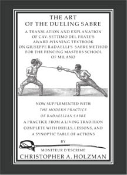 The second is the Art of the Dueling Sabre by Christopher A. Holzman, a double-barreled contribution to sabre fencing. On his


 Columbia Classical Fencing, LLC