Our regularly scheduled Saturday practice is suspended today in exchange for our Fall Blades and Brew get-together at Logboat Brewing Company. Come join us from 2-4 (or longer) for fencing fun, fresh ale ($5 drafts), and support a local business. Be sure to bring lawn chairs or blankets. Picnics or deliveries are welcomed. Ozark Mountain Biscuit’s food truck arrives around 5PM. Club members, please bring all weapons. Hope to see you there!
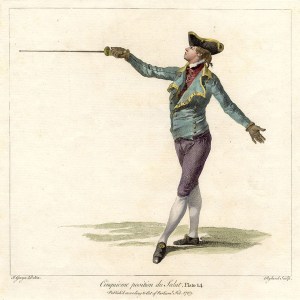
Given our recent focus on structure, and an economy of motion, I thought this quote from Angelo appropriate:
OBSERVATIONS ON THE PARADES IN GENERAL
A GOOD parade is as necessary and useful when well executed, as it is dangerous and fatal if done without judgement, and made wide and rambling.
To parry well, will prevent your being hit; therefore you should observe, when you are defending the place in which you are attacked, that you do not give an opening on the contrary side, which would give more ease to your adversary to throw in a thrust; for which reason you should not flutter, or show the least concern, by any motion he may make, either with the body, his foot, or the point of his sword.
-Angelo, 1787:35
Get a free pdf file of Domenico Angelo’s 1787 edition published by his son, Henry Angelo, at the SmallswordProject.com.
The smallword is a multifaceted and fascinating weapon, the domain of which encompasses such rich topics as history, culture, honor, defense, status, strategy, discipline, grace, and art. It is challenging, both in practice and in study.
Historic texts are scattered across the web in various languages, and accessing accurate information is typically quite cumbersome. Finding skilled swordsmen who can demonstrate historically accurate and effective use of the smallword is an even greater challenge given the rarity of the practice. Further complicating matters are the difficulties in procuring a historically accurate and safe practice weapon, for the market is fraught with disparate sword suppliers who offer wall-hangers of questionable quality or unsafe materials that would fracture if ever put to use.
The Smallsword Project hopes to help remedy these difficulties. The goal is to more easily connect the interested student of the smallsword to historically accurate information. Specific intents are: to provide centralized access to various texts, either in the form of digitized originals/facsimiles in public domain or to translated works for sale; to provide historic context in which smallsword practice emerged; to link individuals to armouries producing historically accurate practice weapons; to connect students to fencing schools, clubs, academies and workshops/seminars where historically accurate smallsword use is taught; to publish historic and contemporary visual media associated with the weapon; and to facilitate an exchange of resources and information among interested parties.
As a result, this blog intends to evolve and develop with your input.Do you know of a new translation or a have you located a nice engraving? Share a resource here. Just wish to learn more? Visit:
Recently, I was privileged to participate in the first ever Martinez Academy of Arms Academia in New Orleans, Louisiana. This was a gathering of all the MAA schools and academies, including Palm Beach Classical Fencing, Côte du Golfe School of Fencing, Salle St. George, Destreza Pacifica School of Arms, and Golden Gate School of Arms. And it was one of the most impressive fencing scenes I have ever witnessed.
Before continuing, I should make a full disclosure: I am not officially a member of the Martinez Academy of Arms or any of its affiliated academies or schools. Moreover, I did not learn to fence under Maestro Ramon Martinez or Maestro Jeannette Acosta-Martinez, and was introduced to the maestri only a few years ago. Nonetheless, I cannot say that I am unbiased.
Since meeting them, Maestri Martinez and Acosta-Martinez have been unimaginably generous to me: teaching me whenever possible, gently correcting my faults, and encouraging me. Unfortunately, due to my Midwest locale, I rarely have the opportunity to learn from the maestri, their provosts, or their instructors. Still, in the brief time I have had with them so far, Maestro Martinez, Maestro Acosta-Martinez, and Instructor Russell Hogg have taught me more about true classical fencing than I can describe and have helped me see how far I have to go.
Moreover, all their provosts, instructors, and students have been unhesitatingly welcoming to me, even though I am an outsider to their community. When speaking with them, they all have invited me to their various academies or schools across the country; when fencing with them, they assisted me in becoming a better fencer.
And it was into this community that I was invited to participate in the Academia.
The Academia
The Academia was held during the weekend of September 18th through the 20th and was held in a gymnasium at the Kingsley House in New Orleans. As Maestro Martinez explained to us, the New Orleans locale was especially significant: it was once considered the Western world’s dueling capital. (Not too surprising, given it’s different ethnic influences from Europe.) New Orleans was reportedly a dueling hot spot, where more duels occurred than in other American city.
At the Academia, several schools or academies from across the country were represented: New York’s Martinez Academy of Arms in New York; Côte du Golfe School of Fencing and Palm Beach Classical Fencing, both in Florida; Salle Saint-George in Washington; and California’s Destreza Pacifica School of Arms and Golden Gate School of Arms.
It was very impressive to see all these different fencers from different states all knowing and fencing the same system. Even though these were students from all over the country, it was as if they were all taught by the same instructor, responding smoothly and uniformly to commands such as “aplomb,” “en garde,” and “advance.”
Moreover, these fencers maintained their form at all times, fencing a very clean and classical style. All this, coupled with their pristine fencing uniforms, made for a very impressive sight. Scanning the gym, seeing dozens of immaculately-dressed fencers wielding their weapons in the classical style, you couldn’t help but imagine that this is what a mid-19th-century French fencing salle must have looked like.
On Friday and Saturday, the day-long classes consisted of a rigorous schedule of instructions in different aspects of different weapons: foil, rapier, sabre (Northern Italian, French, Hungarian), dueling swords, and Bowie knife. Throughout the weekend, we received instruction not only from the maestri, but also from Provosts Jared Kirby, Antone Blair, and Cecil Longino, assisted by Instructors Russell Hogg, Kim Moser, Keenah Suh, Andrew Telesca, and Benjamin Bowles.
The Formal Academia
On Sunday afternoon, there was the Formal Academia at the Kingsley House, where MAA provosts, instructors, and students publically demonstrated different fencing styles with weapons from the 17th to 19th centuries. Called the Grand Fencing Exhibition, this was a well-attended event, and many New Orleans residents showed up to witness traditional fencing.
By all accounts, the Grand Fencing Exhibition was a success for the MAA maestri, provosts, instructors, and students. You can see some pictures from the event in an article from the New Orleans Advocate, which covered the public exhibition as well as one from the Times Picayune. You can see excerpts from the exhibition below or at the lik here.
I have never seen so much fencing talent and knowledge in one place. Nor am I likely to again for some time. The MAA Academia will not be held again for seven years. I can only hope that I am fortunate enough to be invited back.
If you are reading this and would like to become a member of the Martinez Academy of Arms or one of its affiliate schools or academies, check the list below to see if it is an option for you. If you are lucky enough to live close to their salles, I highly encourage you to look them up.
Florida: If you are in Florda, you have two potential outlets.
San Francisco: Golden Gate School of Arms is managed and instructed by Instructor Benjamin Bowles (who also happens to create excellent classical fencing supplies at Benjamin Arms).
Vancouver, British Canada: A student of Provost Longino’s, Joseph Lai oversees the Renaissance Fencing Club, a traditionally French fencing salle.
Patrick conveys the steeped history and tradition of classical fencing to CCF members about to receive club patches. August, 2015.
August was indeed a very eventful month for Columbia Classical Fencing as numerous members earned their club patch, and as we bade adieu to two burgeoning classical scholars. Veteran club members participated in coordinated events on two separate weekends to test numerous club members in classical fencing terms, theory, and in application of form. In completing a rigorous introductory curriculum to classical fencing, newly patched members demonstrated their knowledge of the basics of classical fencing, and earned the right to free-fence in the CCF salle.
Patrick (rear) presents Justin, Michaela, Kristine, Heather, & Logan with their CCF patches. Not pictured, Auden. August, 2015.
Auden earned his patch! August, 2015.
It is with a heartfelt congratulations CCF recognizes the efforts and accomplishments of newly patched members Justin, Michaela, Kristine, Auden, Heather, Logan, Ella, and Clara. They have each shown a focused commitment to learn a historic art steeped in centuries-old traditions, mental acuity, physical discipline, honor, social grace, and history.
Tikvah, Scott, Ella, Kristine, Clara Michaela, Patrick (front-row); Andrea, Francesco, Abe, Chris, Justin (back row). August, 2015.
Additionally, CCF bade adieu to Ella and Clara as they forge new paths in college where they will major in differing aspects of Classical Studies and Near Eastern Archaeology. Secretly, their dad hopes they will also share a thing or two about classical fencing with campus sport fencers. To mark their transition, the club presented each of them with 18th Century framed prints of Juno and Minerva on vellum. This was made possible due to the generosity of club members and the efforts of Chris and Beth O’Keefe in locating and coordinating these gifts. Also, out of his great generosity and desire to spur interest in history and in fencing, CCF member Dr. Scott Lucchese independently gifted a pair of late 19th or early 20th Century foils to Clara and Ella.
Ella, Kristine, Clara. August, 2015.
Patrick inspects students’ form as they prepare to test for their club patches. August, 2015.
As Abe looks on, Patrick presents Clara & Ella with early 20th Century foils, a thoughtful and generous parting gift from Dr. Lucchese. August, 2015.
Chris looks on as Clara & Ella receive historic etchings of Minerva and Juno from CCF. The O’Keefes were instrumental in locating and coordinating these gifts. August, 2015.
Clara & Ella were presented with historic etchings of Juno and Minerva as part of their send-off gifts from CCF. August, 2015.
Toucher et ne pas l’être
“To touch and not be touched”
Attributed to Molière, toucher et ne pas l’être is the
axiom of classical fencing, and the CCF motto.
Special thanks to Andrea & Kent for sharing photographs.



 Columbia Classical Fencing, LLC