Foin /fɔɪn/
Archaic. Etymology: From Old French foene, Latin fuscina (trident).
noun (plural foins)
- a thrust or any varying thrusting weapon.
verb (foins, foining, foined)
- to thrust with a sword or stab.
See also French: fouine (a marten).


Archaic. Etymology: From Old French foene, Latin fuscina (trident).
noun (plural foins)
verb (foins, foining, foined)
See also French: fouine (a marten).

“Royal Armouries – Flamberge & Straight Blades” courtesy of Flickr user savagecats.
Related to the German flammenschwert (flame sword), the flamberge (flame blade) was a rapier variation named for its undulating blade. Found among the upper class in the 17th Century, the flamberge variant is also seen in the transitional rapier, the ancestor of the smallsword.
Flamberges are indeed showy, but it was claimed the waves of the flamberge would inflict more damage in one’s opponent. That claim is somewhat questionable. Regardless, there is little doubt that the undulations in the blade would impart significant vibrations upon contact with an opponent’s blade. This must have been a jarring experience when executing an attaque au fer, or even a simple parry. I suspect that sentiment du fer would be seriously impacted for both parties.
Reminder: due to Independence Day, our Saturday July 4th practice is cancelled. We will resume our regular schedule on Thursday, July 9th.
Given the occasion, here is some related artwork of historic American fencing weapons and accoutrements. They are drawings of one of Washington’s sabres, and the engravings on the coquille of the smallsword presented to Lafayette for his assistance in the American Revolution.
Happy 4th of July!
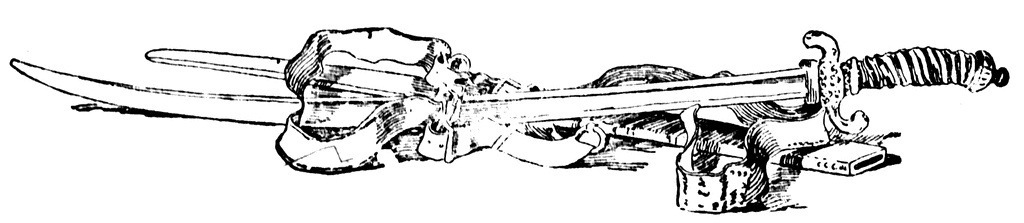
George Washington’s Sabre and Belt. Henry Alexander White, Beginner’s History of the US (New York: American Book Company, 1906) 108.
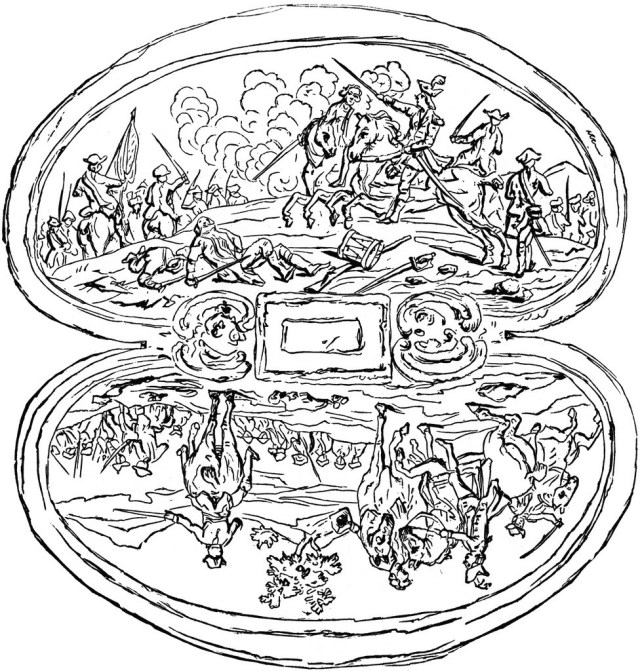
Engraving on Coquille of Lafayette’s Smallsword, reverse.
Benson John Lossing, ed. Harper’s Encyclopedia of United States History (vol. 5) (New York, NY: Harper and Brothers, 1912)

Engraving on Coquille of Lafayette’s Smallsword, obverse.
Benson John Lossing, ed. Harper’s Encyclopedia of United States History (vol. 5) (New York, NY: Harper and Brothers, 1912)
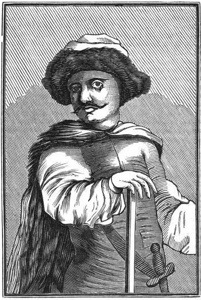
Pirate Captain, Sir Henry Morgan. From The History of the Buccaneers of America by Alexandre Olivier Exquemelin.
My personal interests for all things anthropological & archaeological may be showing, but I think this is a story to watch for anyone interested in historic swords, even though it predates our main focus on the Classical Period. Archaeologists searching for the ship of infamous pirate Captain Henry Morgan stumbled upon a rare intact shipwreck, the remains of the Encarnación, which went down in 1681. This Spanish vessel, not yet looted, in only 40 feet of water, and with good preservation, is a potential treasure trove of archaeological and anthropological information. Although swords are only briefly mentioned, this is a story to watch as it unfolds and we learn more about the weapons in her hold. To read the full story of the discovery and see images of the site, visit this link.
This is your brain on fencing: How certain sports may aid the aging brain.
 Rockwell Classical Fencing shared the following link that summarizes selected research on how fencing affects the aging brain. It is a short summary of an Italian study on the topic, as well as related research. The main point of the research and this story supports the claim that the physical and mental workout integral to fencing is beneficial to the aging brain.
“While younger participants fared better on the tasks than the older ones, both the younger and older fencers performed better overall than their nonathlete peers. “


 Columbia Classical Fencing, LLC