In case you missed it, here is a glimpse of the woes of modern technology on the Olympic fencing piste — LeFort drops his cell phone in the middle of a bout.
(at the time of this publication, NBC is allowing public viewing of this video highlight)

In case you missed it, here is a glimpse of the woes of modern technology on the Olympic fencing piste — LeFort drops his cell phone in the middle of a bout.
(at the time of this publication, NBC is allowing public viewing of this video highlight)
There is something exceptionally satisfying about landing a touch on one’s opponent and having it stick as if dueling with sharps. Rather than a button skipping off-target when landed with a glancing angle, there can be no question about the validity of a touch when your tip grabs its target as if it were exposed flesh on the dueling grounds at dawn.
How can this degree of realism be achieved within the relative safety of the salle? In lieu of a rubber button, one mounts his or her dueling sword with a point d’arrêt (pronounced “pwan de-ray” — literally meaning stop-point), and duels with the added protection of a manchette on the weapon arm.

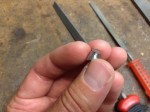
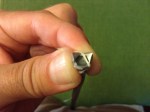
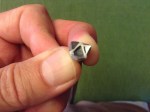
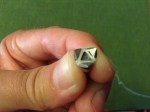
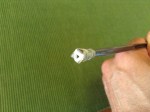
Points d’arrêt are forward-facing, sharp metal teeth mounted on the nail-head of a dueling sword.
What exactly are points d’arrêt? They are a trio of sharpened, forward-facing metal teeth mounted on the nail-head of an épée (dueling sword). When one or more of the teeth land on the intended target, the teeth hold fast to the fabric. Given the use of sharpened teeth, it is essential that a sacrificial manchette protect the entire weapon arm — the nearest target. This also plays into the psychology of dueling with points d’arrêt; the sharp teeth make one immediately aware of the risk faced with sharps, and the prudent fencer shifts mainly to the forward targets of the hand and forearm to reduce one’s own target exposure to your opponent’s point d’arrêt.
Given the relative rarity of classical fencing compared to sport fencing, the use of point d’arrêt with dueling épée is quite a rare occurrence, and their manufacture even more rare. Rockwell Classical Fencing does produce them. However, in the interest of historic preservation and education, the aim of this post is to illustrate how I manufacture points d’arrêt with basic workshop tools. I have done so by following the gracious advice and techniques given to me by master swordcutler, Dennis Graves of No Quarter Arms. His manufacturing techniques are elaborated upon and illustrated here with his permission — and with my sincere thanks.
A Disclaimer
The manufacture and use of point d’arrêt presents an elevated level of risk of damage to fencing jackets and gloves, and an elevated risk of accidental physical harm. One should never use point d’arrêt against an opponent without protective gear in addition to standard fencing equipment, including protective manchettes. What is contained herein is how and what I do. Any choice to follow the steps illustrated here to manufacture, mount, or to use points d’arrêt are done at your own risk.
Tools & Materials for Manufacture
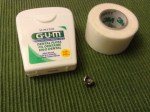
The capscrews are heavy modified and formed into points d’arrêt. Plan on extras since you will likely use a couple to get the procedure and your technique honed.
For an enlarged view of each step to create point d’arrêt, click on any photograph in the two galleries below.

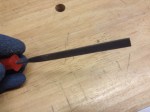
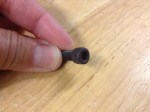


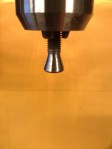
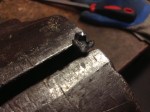
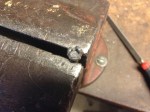
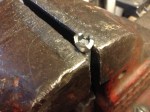
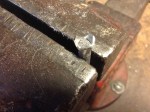
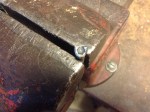
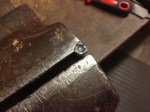
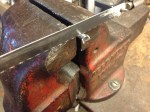
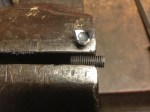

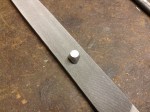

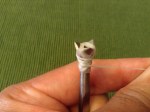
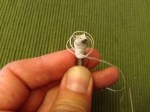
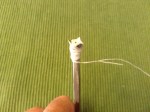
In addition to illustrating the manufacture of points d’arrêt, I have also attempt to illustrate how I mount them to an épée’s nail head. My mounting process is based on the very little I have been able to find published on the web, my tying and lashing experience, and the advice of Scott “Doc” Lucchese, CCF’s Médecin de Salle.


As always, your feedback and/or advice would be welcomed either by submitting comments to this post below or via the Columbia Classical Fencing page on Facebook.
Given the upcoming Olympic Games, this video is again being shared in the fencing community. If you have not seen it, you will likely find it interesting. It features Gaudin, Ducret, and Parrodon with multiple weapons. Classical fencers will recognize a style that is transitional between classical fencing and the sport fencing of today.

Western High School Fencing Club, 1925. Library of Congress.
Our regularly scheduled Saturday practice is suspended Saturday May 7th in lieu of the Spring 2016 Blades and Brew at Logboat Brewing Company. They have a wonderful venue for outdoor fencing and a fine assortment of adult beverages. It is also among our last chances to fence Justin and Michaela who will soon be moving out of state to pursue professional opportunities.
Come join us from 2-4 (or longer) for fencing fun, fresh ale ($5 drafts), and support a local business. Be sure to bring lawn chairs or blankets. Picnics or deliveries are welcomed. Ozark Mountain Biscuit’s food truck arrives around 5PM. Club members, please bring all weapons. Hope to see you there!


 Columbia Classical Fencing, LLC