
Early in western fencing’s history, the nonsword hand played an important role. And, as usual, Italian masters led the way.
Achille Marozzo’s 1536 Opera Nova instructed readers as to how to hold a sword and a buckler. For a multitude of pictures from Marozzo’s work, click here.
Camillo Agrippa also discussed extensively the rapier and dagger. His 1553 Treatise on the Science of Arms also addressed not only fighting with a shield but also hafted weapons. To see pictures from Agrippa’s treatise, click here.
Increasingly, though, later writers focused on the sword and dagger. For instance, in 1606, Nicoletto Giganti wrote about using the rapier and dagger. But he also taught how to fence with a rapier alone, using the left hand to deflect or control the opponent’s sword arm.
But what about the Italians’ Gallic neighbors? Following the Italian example, French authors eventually began writing their own fencing treatises. However, they started off doing things a little differently.
Early French Fencing Writers
The earliest French writers tended to dispense with both shield and dagger, relying upon the “l’épée seule.” Henri Sainct-Didier (1573) set the early example for the French in using the off hand, excluding any use of weapons in the nonsword hand and instead relegating it to disarms.


Sainct-Didier’s Disarm
Notably, Sainct-Didier was excluding the dagger at a time when prominent Italian writers were still using such sidearms.
Eighty years after Sainct-Didier, the next major French fencing treatise streamlined even more. Charles Besnard’s 1653 treatise—whose title noted that it discussed “the art and practice of the single sword and foil” (emphasis added)—recommended not using the nonsword hand at all.
A notable exception to these two French examples is François Dancie’s 1623 L’Espee de Combat ou L’Usage de la Tire Des Armes. Initially, Dancie agrees with the first French examples and condemns coupling the dagger with the sword. Importantly, Dancie wrote at a time when the French nobility, as a class, were frustrated with how the emerging noblesse de lettres (those who had purchased, rather than inherited, their nobility) and the noblesse de robe (high ranking administrative and government officials) were gaining privileges from the French king that were previously allotted only to the noblesse d’épée (i.e., the “nobility of the sword” or the traditionally aristocratic nobility). At the time of Dancie’s treatise, then, the French aristocracy was jealous of the way these bourgeoisie were allowed to imitate them and, consequently, looked for ways to distinguish themselves from such “commoners.” This Zeitgeist seems to have permeated Dancie’s thoughts on fencing:
Nobles never wear a dagger, let alone carry one in the hand, this being more for a bloodthirsty villain than a gentleman, who would only use one if assigned in a duel.
But, with the sword alone, they adorn and support themselves with the best company and accessory, the most recognizable to show its greatness in repelling the enemy, if he dared to confront it.
Thus, I say that the sword is a great man’s finest plume, without which he cannot be distinguished from the financier, merchant, or bourgeois, whom the insults of our times allow to dress as well as the great man.
Nonetheless, Dancie’s high-mindedness seems to have conceded to the necessities of the time: in his text, Dancie taught not merely how to defend yourself against a sword and dagger, but also how to use a sword and dagger.
(As I write this, I can’t recall any other French author doing this for another 300 years when Georges Dubois—whom some have justifiably called the “the forgotten master of l’escrime ancienne”—would advocate for a French return to rapier-and-dagger play. Check out some of that action here. I expect some readers out there will be able to point us to French authorities using dagger and sword.)
A little later, Philibert de La Touche also tried to dissuade the use of the left hand as a parry. (La Touche defined the “parry” to include using the blade to deflect the adverse steel as well as hand parries and, more broadly, any “other method to avoid being struck.”) In his 1670 The True Principles of the Single Sword, La Touche wrote:
The best and most sure parries are made with the blade, which is why we will only speak of the others after having properly familiarized you with the [blade parries]. . . .
Parries with the hand imitate the parries with a dagger. But I find a great difference between the two and I do not approve of using the left hand for the same purpose. For the dagger has a large guard, a blade of twelve to fourteen pouces [a pouce was about one inch], ensuring that it is covered entirely, the left part meeting the front of the enemy’s blade and easily deviating the thrust. But it is not the same with the hand because this parry obliges you to expose the entire left side to the enemy without any other defense but the hand, which cannot go as far to meet the [enemy] blade. Nor does not it have as much time and space to parry as the dagger, which can meet the point of the enemy’s blade at three feet from the body. Further, the hand, being completely unarmed or covered only by a simple glove, can easily be cut by an estramaçon [a heavy, two-handed sword still being used at the time] or pierced by the point to the arm or body . . . .
However, Besnard and La Touche’s grim warning notwithstanding, later French fencing authors generally found a reason to use the (increasingly unarmed) left hand.
“Attaching the Opponent’s Hand to His Body”
Eighteenth-century French authors, such as Labat in 1734 and P.J.F. Girard in 1736, recommended using the left hand to oppose incoming blades. For example, Girard wrote:
To oppose with the left hand, you must be well en garde, as it is said, steady on your feet, the left leg bent, and the upper body carried well to the rear, with the right hip pulled in. If the enemy thrusts quarte inside, or if you make the same thrust, I would have you oppose his sword with your hand, lifting the left elbow, advancing the hand underneath the bend of the right arm, the end of the fingers and thumb hanging downward, presenting the inside of the hand to the outside. In this position, I would have you parry the [adversary’s] blade with the opposing hand and riposte straight inside while closing measure, the hand well supported and turned to quarte, the fingernails above, then redouble and recover back on guard, the sword in front of you.
Girard’s use of “parry” in that last sentence can be misleading. (For you French readers out there, he writes “je fais parer de l’Epée ladite main opposée.”) Judging from other parts of his text, Girard certainly does not mean to use the left hand to deflect an incoming blade. Later in his treatise, he shows the reader how to fight those who take on a low guard and “neglect to parry with their sword in order to parry with their left hand.” Against a person carrying a sword and a dagger, he even distinguishes how the attacker parries with the “left hand, the dagger, or the cane” while instructing his reader to counter-attack and oppose with the left hand as explained above.
In fact, French authors generally emphasized the distinction between parrying with the left hand and opposing with the left hand. In making this distinction, the authors frequently summarized the ways of parrying with the left hand, i.e., sweeping the incoming blade from low to high (generally considered the most dangerous); from high to low; and laterally to the side. In 1692, Wernesson Liancour disapproved of two of these:
I address in this chapter the two types of parrying with the hand: the first is by lowering the thrust downward and the other is by lifting and casting the thrust above the head. Both are very dangerous because it often occurs in combat that we see the hand of him who wished to parry being attached to his body. Thus, this way of parrying is very dangerous . . . because the parry of the sword is always neglected in order to use the hand.
Although they touched upon these methods, the French writers tended to make clear that these ways of parrying were disfavored.
Instead, the 17th and 18th century writers preferred the left-hand opposition and consistently specified that you only use the left hand after the sword has parried the incoming blade. Again, after observing that it was natural for a person to use his hand to deflect an incoming thrust, Liancour emphasized the difference between using the left hand to parry and to oppose:
I begin by distinguishing between parrying with left hand and opposing with the left hand, something about which few people know the difference. The opposition of the left hand . . . is when, the sword having had its effect in parrying, you must add the left hand and arm to [the completed parry] in case the enemy’s sword comes to form angular and traversing lines, which the sword would not be able to parry without a volte of the body, which would be very perilous, as I will show. . . .
And, in 1736, Michel Martin was just as explicit:
There are some people who confuse opposing with the left hand with parrying with the same hand. This error reveals those who have been laboring under bad principles or who have not been using principles well established in the art of arms. For this opposition is only made after having parried the blade, not only to evade a bad thrust when we riposte straight and without interruption, but also to prevent the thrusts that the enemy directs toward us with a turned hand from having their effect.
By “with a turned hand from having their effect” (en tournant la main n’ait leur effet), I confess I am not sure whether Martin means (1) an attacker with an inside-opposing hand that is sufficiently angulated and firm to defeat an attempted parry or (2) an attacker who thrusts “en cavant”—that is, with a wrist angulated contrary to opposition in order to distance the blade from the adverse blade and thereby land the hit. (This latter interpretation may be what Liancour was referring to when he mentioned the adverse blade forming “angular and traversing lines” around the parrying sword. Roughly translated, en cavant means while or by caving or sinking in; in this context, en cavant makes sense if you imagine the attacker’s wrist “caving in” by forming a sharp angle one way or another. If you are interested, scroll down to “cavé” on CCF’s terms page.)
In any event, opposing as necessary with the left hand on an inside thrust seemed to become pretty standard advice for the late 17th and early 18th century French writers. In 1754, Gerard Gordine (a military officer and fencing master) published his Principles and Quintessence of Arms, which recommended using the left-hand opposition against those who attempt to thrust en cavant.
Interestingly, Domenico Angelo’s 1763 School of Arms did not limit the left-handed opposition to an aid to the parry. He taught the left-handed opposition to secure the enemy blade while thrusting the flanconnade. As a matter of defense, though, he did teach the left-handed opposition after making the prime parry because, from that particular parry, it is difficult to maintain inside-line opposition on a riposte in prime:
When parrying [prime], the opposition of the left hand is made by closing the measure in order to avoid the point of the adversary’s sword in case you want to respond with a riposte in the same line.
Still, Angelo preferred compassing off the line of direction after parrying prime rather than opposing with the left hand:
To move from the line at the same time that you parry his thrust: to do this, you must, in the same instant, carry the right foot flat and steady six pouces to the right and, toward the same side, follow with the left foot about a foot, thus moving away from the center. In my opinion, this action is preferable to opposing with the left hand. Because it is practiced in many schools, especially those in Italy, an explanation was thought appropriate.
The reason why this last method is preferable to the first is because the two swords’ points are low and inside. It would be better to move from the line in order to make your riposte because then you see the adversary’s entire left side exposed.
For its 1786 edition, the Encyclopedie Methodique —a successor to Diderot’s Encyclopedie—defined “Opposition” as a movement of the hand that parries a final thrust. But then, in explaining it, it quoted Girard’s explanation above word for word.
However, as time went on and as fencing began to include far less lethal transactions, the French writers’ warnings began to change a bit.
Preventing le Double Touche
As noted above, the earlier French authors discussed only the dangers of parrying with the left hand, such as having it evaded or having your hand transfixed to your chest by the adverse blade. At a time when fighting with a sword at some point was a possibility for many individuals, these warnings were well placed.
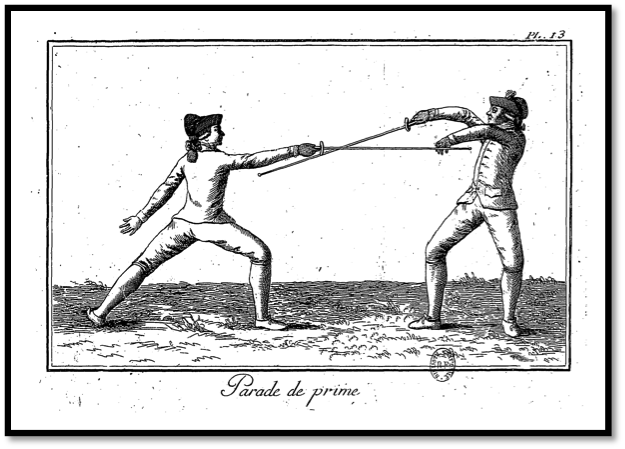
However, with the emergence of the rebated blades and foils, fencing became an athletic pastime in its own right. Thus, later French authors began referring to the necessity of left-handed opposition to prevent a “double touch.” In his 1778 New Treatise on the Art of Arms, Nicolas Demeuse wrote that it is “necessary to oppose the reversed left hand at the height at the chest, the elbow outside in order to prevent the enemy from making a double touch.” The accompanying picture distinctly shows buttoned foils, suggesting fencing practice or exercise.
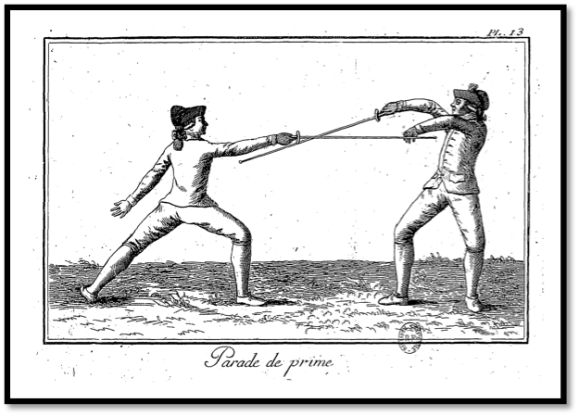 Demeuse’s Prime Parry with Left-Handed Opposition
In a similar tone, M.C. Navarre, a recognized French fencing master, wrote the 1775 Military Manual or the Art of Victory with the Sword. Despite his short book’s militant title, Navarre recommended that “a good athlete” should base his fencing on thrust, feints, and parries that keep him safe with opposition. Consequently, concluded Navarre, actions such as parrying with the hand could only be detrimental to such a good athlete. (Navarre did allow for the volte if the opponent had never handled a foil before because he would thus not be familiar with time thrusts.)
This theme continued in the nineteenth century. Of course, bladed duels still existed, but using the pistol to satisfy honor was on the rise. This freed fencing even more to be an elegant exercise, allowing fencing writers to begin distinguishing salle fencing from dueling-ground fencing (or as they were wont to say, “a serious affair”). In the nineteenth century, salle fencing would include strokes that were brilliant or exquisite to behold but too risky for the deadly dueling ground.
For salle fencing, French writers thus had to address those who would intentionally attempt to extend into your attack in a fencing bout. For instance, Gomard’s 1845 A Theory of Fencing allowed for the left hand to be used against an opportunistic opponent, even with a foil. (Note that, when Gomard refers to thrusting “en cavant” here, he is describing how the defender’s wrist shifts from an angulated position (for the quinte or prime parry) to a straightened position to deliver the thrust: it is the parrying wrist that thus “caves in,” away from the attackers blade.)
In fencing, there is the principle that the fencer who attacks should be covered, that is to say, protected from the enemy steel’s reach in the line where the attacking fencer delivers the thrust. Because, among the eight bottes, prime and quinte do not allow opposition with the blade—in that you can only thrust them en cavant—it is necessary therefore for these two to break with the principle of opposition or to have resort to opposition with the left hand. . . . If you are fencing with adversary who seeks to take advantage of the opening to your body that is created when thrusting one of these two bottes and tries to place his blade there, oppose with your left hand so as to close that line to your body. But only in the case only where the adversary wants to exploit your opening.
However, added Gomard, “[i]n a serious affair, you should abstain from using the left hand, due to the untoward interpretations which its usage can give rise to.”
Just a few years later, the 1864 treatise Arms and the Duel suggested that that any use of the left hand was on the way out. In addressing the evolution of the left hand’s use, fencing master Augustin Grisier concluded that, ultimately, deploying the left hand was both unnecessary for defense and too risky for one’s honor:
We see therefore that, at all times, the left hand played an often-indispensable role. But today, we no longer hold the sword in one hand and a dagger in the other; we no longer have a heavy sword that must be held with two hands; today it is no longer our custom to split hairs: our combat is frank, loyal, and with an unprotected chest. Today we ask for no more than an equal share of terrain and sun while praying to God to protect the just cause. Today, a single sword can protect us, and we no longer need the left hand.
As for me, I completely agree with Charles Besnard, who, in 1653, recommended to never use the left hand; I say with him that this movement is vicious and dangerous. . . .
If you wish to use the left hand because the adversary wants to make a double touch and use opposition in this case (as the professors teach), you will be told, “You judge wrongly, I did not want to [make a double touch].” . . . .
Finally, if you use the left hand, you can involuntarily seize your enemy’s sword, causing it to be said that you are disloyal; if you wound him in that moment, you will be treated like an assassin.
Other times, other customs. Today, witnesses readily defend using the left hand. In principle, it is no longer used. Without its assistance, we can protect ourselves from all the thrusts. If an amateur does not know how, I can teach him. A man who wants to make a double touch by extending the blade can be defeated in different ways without using the left arm.
Of course, with the emergence of modern fencing, the left hand was eventually eliminated from standard foil play. Today, though, using the off hand has again found a place in the practice of historical and classical fencers.
- For further information on the conflicts between the French nobility and emerging, competing classes, see Frederic J. Baumgartner, France in the Sixteenth Century, St. Martin’s Press, 1995, and Davis Britton, The French Nobility in Crisis, 1560-1640, Stanford, 1969.
- For more on Camillo Agrippa, I recommend Dr. Ken Mondschein’s translation of Agrippa’s work titled Fencing: A Renaissance Treatise.
- Tom Leoni’s translation of Giganti’s treatise—Venetian Rapier: Nicoletto Giganti’s 1606 Rapier Fencing Curriculum—is very accessible.
A pdf version of this post can be found here.


 Columbia Classical Fencing, LLC