The twins and I missed practice today, but enjoyed the National WWI Museum in KC. These may be of interest.
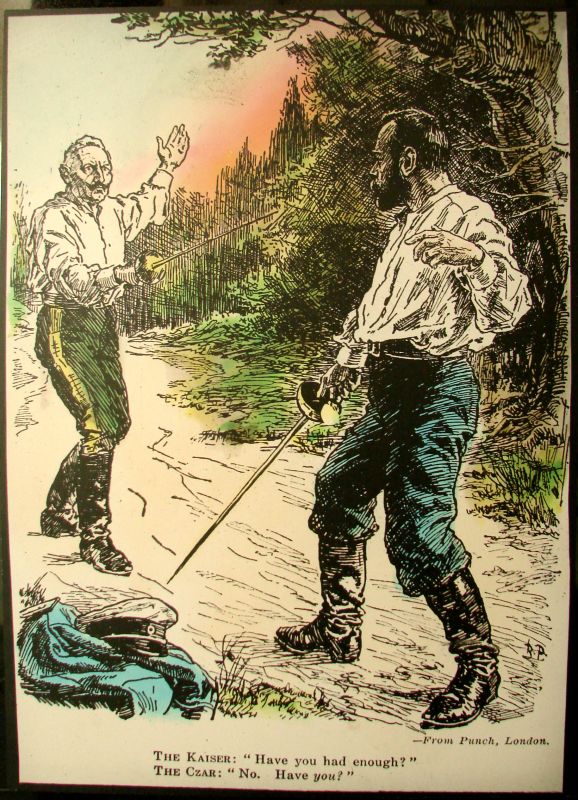
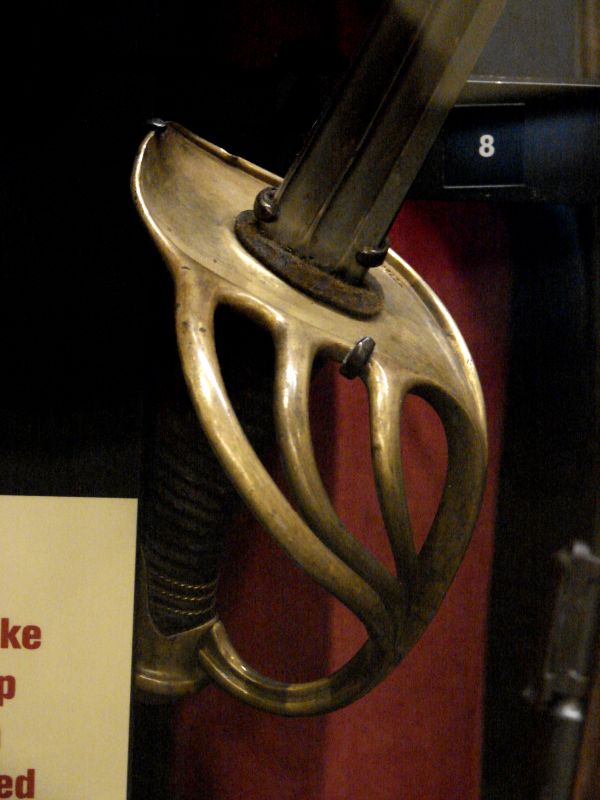
French Dragoon Sabre Hilt, Model 1882. National WWI Museum, Kansas City, MO.

The twins and I missed practice today, but enjoyed the National WWI Museum in KC. These may be of interest.
French Dragoon Sabre Hilt, Model 1882. National WWI Museum, Kansas City, MO.
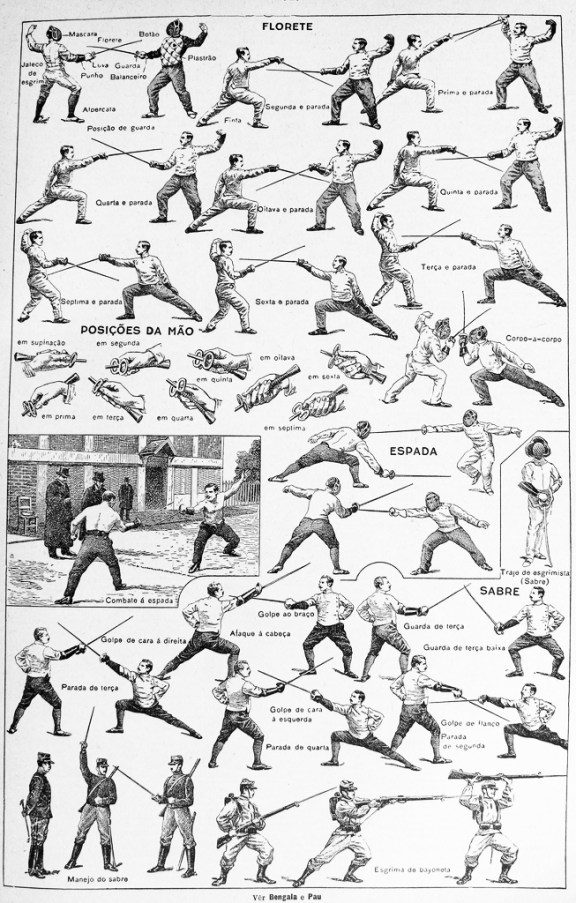
My last post showing a French fencing diagram generated several views from throughout Europe. As a result, I thought this similar image may be of interest. It may be Portuguese in origin, or perhaps Spanish or Galician. The source that published this to the web did so without explanation or citation. Similar to the prior post, it appears to be from an illustrated dictionary for an entry on esgrima and also appears to be from circa 1915, but those are speculations. Any corrections or insight would be welcomed.

From an illustrated dictionary, 1916.
 Doña Ana de Mendoza, the Princess of Éboli, is a woman full of historic intrigue and mystery. Fascination of her is fueled not only by her legendary beauty, courtly manipulations, and murderous plot, but also the mystery surrounding an alleged fencing accident and her eye patch. She has captivated attention for centuries, been immortalized in opera by Verdi, portrayed in Hollywood by Olivia de Haviland, and is the subject of numerous books and video productions. So who is Doña Ana de Mendoza and why is she wearing an eye patch?
A Very Brief Biography
Born in 1540 into the powerful house of Mendoza, Doña Ana was the daughter of Diego Hurtado de Mendoza and Catherine de Silva. Doña Ana endured what appears to be a dysfunctional home life as a child, including the embarrassment of her father’s infamous philandering, something not accepted in 16th Century Spain. Little is known of Doña Ana’s childhood, but she was described as passionate, intelligent, religious, and rebellious in her youth. It is alleged that during her early adolescence, and prior to the development of safety equipment, she lost her right eye in a fencing duel with a page. In part, it appears the juxtaposition of her renowned beauty and her eye patch has fueled a mystique that has captivated admirers for centuries. Admittedly, it was her formal portrait with her prominent eye patch and rumblings of a fencing accident that first piqued my interest to learn more about her.
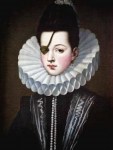


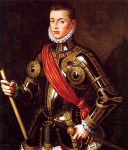

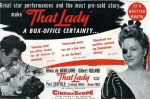
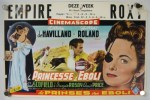

An early arranged marriage to Rui Gomez enabled Doña Ana’s presence in the court of King Philip II of Spain. Her husband’s wealth and influence provided for financial security and titles following acquisition of estates in Eboli, located on Italy’s southeast coast. Her husband’s death and her subsequent relationship with Antonio Perez proved to be a fateful turning point for Doña Ana. Like her husband, Perez was a powerful insider in Philip II’s court. Perez brewed a plot of manipulation between the King and his half-brother involving a rebellion in Flanders and perhaps a move toward taking power in Portugal. When whiff of the plot was sensed, Perez orchestrated a murder to squelch its further discovery. Doña Ana, said to have had involvement in the plot, was imprisoned by the King and subsequently stripped of parental rights and property. Some claim she was treated very harshly by the King, in part due to his sexual jealousy and sense of betrayal, but as with her eye patch, there is a dearth of supporting evidence for such claims. She would die sick, lonely, and imprisoned.
The Fencing Accident?
Numerous and widespread explanations for Doña Ana’s eye patch abound. They typically assert in matter-of-fact fashion that Doña Ana lost her eye in a fencing accident involving a page, perhaps around the age of twelve. However, absolutely no evidence has come to light to support such claims. They appear to be the speculations of historians attempting to explain her portrait — assertions that have much more intrigue than the lesser-known speculations surrounding a horse accident around the age of fourteen.
Did she lose her eye in a fencing accident? Was her condition congenital or is there another explanation? Fascination with Doña Ana, especially in Spain, has prompted a 2012 ophthalmological analysis. Of course, Doña Ana cannot be directly examined so Dr. Enrique Santos-Bueso, of the Neurological Unit in the Ophthalmology Department of the University Hospital Clinico San Carlos, was forced to examine his patient based on what little evidence that exists: a formal portrait and brief accounts of Doña Ana’s literary habits (Matey).
In a close examination of a portrait, Santos-Bueso claims Doña Ana’s right browridge is smaller and lower than her left. This leads Santos-Bueso to conclude she likely experienced trauma that may or may not have perforated the eyeball, but did result in atrophy of the eye and alteration of the facial bones and structure. The lack of recorded chronic health issues associated with her eye is cited by Dr. Santos-Bueso as further indication of blunt trauma. He asserts that, because Doña Ana did not [reportedly] suffer from persistent infection or chronic inflammation at a time when modern pharmaceuticals were unknown, she likely experienced trauma. Santos-Bueso also dismisses indications of other ocular issues. According to Fernandez, a Doña Ana researcher and author, there are accounts of Doña Ana using large print texts and a stencil for writing. Santos-Bueso asserts this can be explained by the possibility of nearsightedness from youth (Matey).
Portraits are subject to interpretation by the artist. It is not clear if Santos-Bueso examined more than one portrait. If so, were they painted by more than one artist and did they show the same facial features upon which Santos-Bueso basis his conclusions? It seems highly spurious to draw detailed conclusions based on the visual interpretations of one artistic individual.
Parsimony is a virtue. I cannot help but wonder if an explanation simpler than historians’ speculations and Santos-Bueso’s assertion is more likely, especially in the absence of firm accounts of an accident. Could Doña Ana have simply endured a physical condition that was socially unacceptable for Spanish high society? Would it be permissible for a daughter of Spanish aristocracy to openly exhibit a physical deficiency, especially one that disfigured the face? I wonder if her eye patch could simply have been covering what is known in America as a “lazy eye” (amblyopia), a common occurrence seen in approximately seven percent of children. I strongly suspect a cross-eyed princess would not have been acceptable. As it turns out, a main cause of “lazy eye” (amblyopia) is nearsightedness (myopia) — the very condition Santos-Bueso uses to explain Doña Ana’s use of large text and writing stencils.
I don’t claim to have conclusively solved the mystery of the princess and the eye patch. And I am not convinced that Santos-Bueso has either. We still don’t know if her eye patch is due to a fencing accident, despite the pervasive assertions. With other things being equal (namely the absence of a known accident), the simpler explanation is more likely. Although lacking the intrigue of a “beauty disfigured in fencing accident”, nearsightedness leading to amblyopia seems much more likely, though far less romantic.
###
A Bit More Biography
For those interested in more details about dramatic events of Doña Ana’s life, read on. Not being a Spanish speaker, it was with some difficulty that I attempted to unravel the story of Doña Ana. Many of those details are tangential to the issues surrounding the mystery of her eye patch and alleged fencing accident. Below are more details of the tangled web that was Doña Ana’s life and death.
Her Marriage
Under the advisement of King Philip II, she was betrothed at age twelve to a Portuguese nobleman, Rui Gomez da Silva, the King’s personal secretary and life-long courtier, who was 24 years her senior. A few years later, Rui and Doña Ana’s marriage would be consummated and she would go on bear Rui their first of ten children. Like her husband, Doña Ana became well established in the court of King Philip II where she enjoyed a close relationship with Queen Elizabeth of Valois, the king’s third wife. It is during this time that some allege Doña Ana became the King’s mistress, but this is denied by several scholars. Whether fictional or otherwise, such allegations have helped fuel dramatic (and largely fictional) story lines on stage and screen, furthering Doña Ana’s mystique. At about this time, Doña Ana’s parents became further estranged, and her father left with another mistress.
Doña Ana’s husband, Rui Gomez, worked to secure their children’s future by purchasing the town of Eboli in Naples, as well as several villas. Rui was granted the title Duke of Pastrana and Grandee of Spain by Philip II in 1572. This established Doña Ana as the Princess of Eboli and the first Duchess of Pastrana. Her husband died the following year. Thus began a series of problematic and dramatic chapters in Doña Ana’s existence. In grief, Doña Ana and her mother moved to the convent in Pastrana. While there, she was described as the “Princess Nun” where she apparently had a rocky relationship with the other nuns, who eventually left the convent (J. Peace).
Doña Ana’s Demise
A few years later, Doña Ana and her mother returned to Madrid against the Kings wishes. Not long after, her mother died, followed shortly thereafter by her father. However, her father, having married another in an attempt to secure a male heir, had left his second wife pregnant, threatening Doña Ana’s inheritance.
Doña Ana’s husband was succeeded by his protegé, Antonio Perez, as secretary to Philip II. Antonio Perez, only slightly older than Doña Ana, was a married man. Doña Ana established a close relationship with Perez, and again, adulterous allegations abound, but some claim their relationship was purely political. Their relationship was apparently hidden from the King. Historians are divided as to why that was the case with some claiming it was due to impropriety (given Perez’ marriage), while others claim it was due to Doña Ana’s renewed liaisons with the King. Regardless of truth, Doña Ana’s relationship with Perez deepens her intrigue in Spanish legend and serves as a turning point in her life and in Spain’s history.
Perez, a trusted secretary to Philip II, became caught-up in a revolt that developed in Flanders. The Duke of Alba and Don Juan of Austria (half-brother of Philip II) were intertwined with Perez in this revolt. Perez offered to serve as a mediator in the conflict, however, he was playing both sides. He altered state communiques between the King and Don Juan, and sold state secrets. Doña Ana was apparently aware of Perez’ treachery vis-à-vis their close relationship, evidenced by their visitations, and exchange of opulent gifts. Don Juan’s personal secretary, Juan de Escobedo, previously allied with Perez as his spy against Don Juan, turned against Perez and also discovered the relationship between Perez and Doña Ana. At this point, it is alleged that Perez and Doña Ana conspire to assassinate Escobedo. Some historians assert Doña Ana was not an active participant in the plot, but was merely complicit. Though several more machinations in this operatic saga occur, Philip II discovered the treachery of Perez and Doña Ana. Perez held off trial for several years, having somewhat assuaged Philip II with accusations of Don Juan’s pernicious intentions towards Philip’s throne.
However, Doña Ana was placed under house arrest in 1581. The King stripped Doña Ana of her parental rights and property in 1582. This relatively harsh treatment of Doña Ana helps fuel allegations of the King’s sexual jealousy and romantic relations with Doña Ana. In 1589, ten years after the discovery, Perez was finally charged with the murder of Escobedo. This led to riots and unrest by Perez’ supporters. In 1590 Perez escaped to Aragon. Perez, in exile, published scathing, defamatory accounts of King Philip II’s court, assertions that went unchallenged, contributing to the Spanish Black Legend. Doña Ana, imprisoned for a decade, eventually died depressed and ill in 1592.
Works Cited
“Amblyopia: Lazy eye.” PubMed Health. 2012.
http://www.ncbi.nlm.nih.gov/pubmedhealth/PMH0002009/
Anguissola, Sofonisba. Porträt des Philipp II. 1564. Oil on canvas. Prado Museum. http://en.wikipedia.org/wiki/File:Portrait_of_Philip_II_of_Spain_by_Sofonisba_Anguissola_-_002b.jpg
Ares, Nacho. “La Princessa de Éboli.” Ikerjimenez.com. N.p., n.d. Web. 25 Feb. 2013. http://www.ikerjimenez.com/especiales/eboli/index.html
Synopsis of a book review on Princess of Eboli.
“Éboli. Secretos de la vida de Ana de Mendoza.” nachoares.com. N.p., 2005. Web. 27 Feb. 2013. http://www.nachoares.com/html/libros/eboli-ana-mendoza.htm
Biography by Nacho Ares.
De Paz, José L. G. “La descendencia del Gran Cardenal Mendoza.” Mendoza Poderosos Senores. Universidad Autonoma De Madrid, 19 Dec. 2000. Web. 27 Feb. 2013. http://www.uam.es/personal_pdi/ciencias/depaz/mendoza/anaeboli.htm
Academic biography of Dona Ana Mendoza.
IMDb. Amazon.com, n.d. Web. 25 Feb. 2013. http://www.imdb.com/title/tt0048712/
“La princesa de Éboli.” Wikimedia Commons. N.p., n.d. Web. 25 Feb. 2013. http://commons.wikimedia.org/wiki/File:La_princesa_de_%C3%89boli.jpg
Matey, Patricia. “¿Por qué la princesa de Éboli llevaba un parche en el ojo?” ELOMUNDO.es. N.p., 23 Apr. 2012. Web. 25 Feb. 2013. http://www.elmundo.es/elmundosalud/2012/04/20/noticias/1334939068.html
Analysis of eye pathology depicted in portrait.
O’Brien, Kate. “Ana de Mendoza y de la Cerda.” Flickr: Kate O’Brien Creative. Yahoo!, 11 Mar. 2012. Web. 27 Feb. 2013. http://www.flickr.com/photos/eyecandyforthebrokenhearted/6971736091/in/photostream/lightbox/
Photographic Recreation of Dona Ana portrait, 2012.
“Portrait of John of Austria (1545-1578).” Wikimedia Commons. June 2011. Web. 9 Mar. 2013. http://en.wikipedia.org/wiki/File:John_of_Austria_portrait.jpg
Portrait of Don Juan, also known as John of Austria.
“Princess of Eboli. Ana de Mendoza and De la Cerda.” ArteHistoria. Junta de Castilla y Leon, n.d. Web. 25 Feb. 2013. http://www.artehistoria.jcyl.es/v2/personajes/5614.htm
Recently, I’ve been trying to drill down on the French authors’ conceptual and mechanical distinctions between fausse attaques—i.e., false attacks—and feints. Although ostensibly different, it appeared to me that the boundaries between false attacks and feints could easily be blurred. To better make the distinction for my fellow fencers at CCF, I pulled out my (frankly limited) resources to see what the 18th– and 19th-century French authors had to say for themselves.
Besides getting a better understanding of the feint and the false attack, I noticed an evolution from the late 1600s to the late 1800s, one that no one ever pointed out to me. That is, as the French authors described it, the false attack appeared to develop strictly from the foil; apparently it was an indulgence of the 19th-century salle. Thus, we see little to no recognition of it in the usual small-sword treatises, which tended to focus on the tried-and-true feint.
First, let’s get our terms straight. The difference between the false attack and a feint was made clear by Antonin Gomard, who was very punctilious about his definitions. In his 1845 Theory of Fencing, Gomard distinguished the two.
The false attack is a display of an attack by some movement with the blade, the legs, or the body, making the adversary believe that you are going to attack. It is difficult to precisely identify the false attack because it fakes, more or less, a real attack. Most often, the false attack is made by an absence of blade with a forward bodily movement, accompanied by an appel. The false attack’s goal is to rattle the enemy and to expose his parry’s movement in order to profit from the enemy’s disorder or reveal his plans.
Gomard’s contemporary, Augustin Grisier, agreed: “The principal goal of the false attack is to see if the adversary wants to thrust at the same time as you.” Modern fencing uses the term “probing action” to describe what was once called the false attack. This is an apt term, as it makes clear that one is probing, seeking information.
As for the feint, Gomard defines it as “a faked thrust. It is the way to draw the enemy steel to another line by faking an attack, so as to strike in another.” Those authors writing about the feint made clear that it was not intended, unlike the false attack, to merely make the opponent react. For instance, in his 1836 Manual of Fencing, Captain de Bast described the feint as “the simulation of a hit that is made before lunging, in order to force the adversary to expose himself, so as to reach him more easily.” (Emphasis added.) Grisier specified that the feint was “a movement of the sword which has its goal to divert the adversary’s attention from the idea of the hit that one wants to deliver.”
As noted, the false attack as Gomard and others define it does not seem to have been identified as such until the 19th century. For instance, Domenico Angelo seems to be referring to what we could call false attacks when he mentions those “fencers, who feint by making large motions of the body or the point, or large [advances] from the right foot in order to induce the enemy to precipitate his defense . . . .” (Not surprisingly, he disapproves of this practice.)
In one of the last fencing treatises of 18th-century France, M.C. Navarre’s 1775 Manuel Militaire devotes a section to feints and hints at an incipient conception of the false attack: “Feints are movements of the blade that change and deceive the combinations of those who want to thrust or parry. They also facilitate the opening and disturbance of the enemy that you want to take by surprise.” (Emphasis added.) On the other hand, Nicolas Demeuse’s 1778 Nouveau Traité de l’Art des Armes seems to make no reference to something we would identify as a false attack. (The absence of the false attack in Demeuse’s work is notable because his was one of the last significant French fencing texts of the 18th century: evidently it is hard to find time to publish fencing works amongst profound social upheaval, revolution, and pan-European war.)
Indeed, the earliest discrete reference I can find to a “fausse attaque” is in St. Martin’s 1804 L’Art de Faire des Armes Réduit á Ses Vrais Principes. And even then, St. Martin describes the “false attack of the feint of low quarte by an appel with the foot.” Again, this reads like an inchoate notion of the false attack, one still emerging from the feint.
Later in the century, the false attack proper is elaborated by French writers such as Gomard and Grisier, then towards the end of the century with Camille Prévost and Louis Rondelle. And this development is interesting because it closely tracks the foil’s increasing departure from dueling practice towards the 20th century.
For instance, Gomard and Grisier wrote at a time when duels were a comparatively common reality. Both treated the false attack only as a matter of reconnaissance: it was used to “rattle” the enemy or “expose” his plans. In fact, for Grisier, seems to have used it more as precaution than a strategic device: he recommended using it to make sure the opponent would not extend into his attack. In this line of thinking, the false attack precedes taking the risk of lunging at your opponent.
But, as embellished by later French writers, the false attack becomes riskier. It is actually used to draw your opponent’s attack onto you. Thus, by 1891, Prévost uses the false attack to induce the opponent’s parry-riposte so he can counter-riposte. And for Rondelle, the false attack is almost brinkmanship, to be used against a trigger-happy opponent: “The False Attack is very useful against an ambitious adversary who precipitates himself against you at every opportunity, and also against those who favor Time-Thrusts.”
This sort of advice is not consistent with the more conservative feint, which carries a more established lineage than the relatively recent false attack.
The feint was known and used in some of the earliest Italian works. The French writers of the 17th and 18th centuries could only apply to their specific weapons what Italian authors such as Nicoletto Giganti had already said.
Consistently, the French masters instructed that the feint must convincingly indicate a hit in a given line. In other words, the feint must distinctly show, from all appearances, a genuine attack. You must ensure that your signals are clear enough to get the preferred reaction from your opponent. For instance, in 1676, Le Perche recommended that, when making the feint, you “leave the blade’s point in front of the enemy so that the feint represents the hit.”
Hence, as Lafaugère notes, feints should not be made too quickly: feints “are used to deceive the adversary’s parry, that is, to make him parry to the side opposite to where you want to thrust; and if the parries are too rapid, they will be without effect.”
The French masters make clear your opponent needs to be able to detect the action of the feint: an overly fast feint may not send a sufficiently detectable signal. We should not make a fast feint and then immediately proceed to our true attack, ignoring our opponent’s action.
Putting their recommendations together, French writers seem to suggest initiating the feint quickly but then not rushing to the final thrust (what some authors elegantly called “la finale”). For instance, Danet wrote that the feint should “start from the point and be made in the blink of an eye.” Later, Louis-Justin Lafaugère cautioned that feints should be well defined and, as noted, not made too quickly. “The greatest possible speed,” Lafaugère added, should be reserved for la finale.
Thus, by making the feint sudden—Danet’s blink of an eye—the fencer makes his opponent flinch, adding to the reaction. But, by not hurrying to an immediate finale into what is still probably a closed line, the fencer pronounces the feint’s action, ensuring that the opponent opens the desired line.
Indeed, one of the tougher parts of using feints is the readiness to turn them into a true attack if the opponent does not respond. As Angelo notes, “You should not always count on the adversary parrying when you feint, for you can easily be deceived by this.” Likewise, you may have to quickly shift to defense if, rather than parrying, the opponent extends into your feint. To that end, the authors always recommended keeping yourself adequately covered in the feints.
The French authorities agree on a number of points in the feint’s mechanics. A longstanding recommendation with both small-sword and foil practitioners was that the feint should be accompanied by an appel, that is, a stomp of the foot that is supposed to startle your opponent, especially when coupled with traditional “Et, lá!” (Understandably, these appels were ultimately discouraged: imagine a salle full of stomping and yelling Frenchmen.)
Another very typical recommendation was that the feint should be made close to the opponent’s guard. In a rare agreement between these two antagonists, both Danet and Angelo wrote that keeping the blade’s point very close to the adversary’s guard or fort will allow you “to reach him more promptly.” Still, Angelo added that your feint should lead the opponent’s blade far enough away to create the opening in which you want to attack.
Clearly, a light touch is required here. Le Perche added that, when feinting with a petit degagement—a “little disengage”—you should be careful to not allow your blade to touch the opponent’s. No doubt, brushing your blade against his would allow your opponent to detect your petit degagement through his sentiment du fer, giving advance notice of your feint and diminish its suddenness.
Ever advocates of doigté, the French authorities routinely advised using only the fingers to steer the blade in the feints. Danet: “The point’s movements should be subtly made by the thumb and the fingers . . . .” And Gomard stressed that “[t]he thumb and the index finger are . . . the only two making the feints.” The emphasis on using the fingers was reinforced by the constant reminder to “support the point” and ensure that the point moves first when feinting. Presumably, the comparatively slower movement of the hand and the guard would expose you to a counter-attack.
Most authors also agree that the elbow must be a little bent, keeping the arm flexible, while being careful not to lean the body forward. Le Perche again: “you must have the body well to the rear.”
As for the hand, Gomard details its position in the feint:
Generally, the engagements, the feints, and the parries are made in middle pronation or middle supination. Complete pronation or complete supination is only employed for the botte or the end of the final thrust.
Lafaugère called this position “having the hand turned between tierce and quarte.”
The authors agree that you can feint from immobility or while using footwork. You can be in measure when you make the feint, but your timing will have to be spot on: being in measure requires that the deceive happen around the opponent’s blade and not his arm.
Alternatively, you can enter into distance using the feint, but fluidity and continuous motion becomes important, lest you give the signal that you are only feinting. This, in turn, invites the stop thrust.
Today, historical fencers and classical fencers distinguish themselves by asserting that they fence according to the practices of certain periods.
Thus, if you are a small-sword practitioner adhering to 18th-century French principles, then, based on the sources above, you should avoid the false attacks in your fencing. Instead, you would preferably use the feint, heeding Angelo’s advice against making the feint in three motions: (1) advancing the blade, then, upon the parry, (2) pulling back the blade to facilitate deceiving the blade, and finally (3) changing the line while thrusting forward. Angelo notes that “these three motions are contrary to one other, and are so slow, that, if the adversary thrusts at the time that [such fencers] pull back their arms, then they would be touched before they had finished their feint.”
Likewise, if you try to fence classically (that is, consistent with the principles of the 19th century, more or less), then your style may incorporate some false attacks. Although I would consider Rondelle’s application of the false attack to be extreme for the classical fencer, there does seem to be a place for conservative and judicious actions, tailored to your skill level and mindful of your opponent’s measure. For instance, how does the opponent respond to a quick beat on his blade coupled with a small-but-sudden advance from out of measure. Does he retreat? Or does he stand his ground? Does he move his blade? How so? Does he make a motion to extend into your attack?
All the sources agree that you must be intelligent about using the false attacks (and, as a matter of fact, the feints too). If they are not real or too numerous, then you set yourself up for a counterattack, such as a time or stop thrust. You do not have a lot of time to do these things: with each of your false actions you provide the enemy information too.
Indeed, authors advised against making false attacks merely to rattle the enemy, rather than gaining information. Lafaugère called such actions “feints of refinement,” perhaps to suggest they were too precious to be useful. “The feints of refinement are made with the greatest speed; they do not seek to deceive a parry but to make the adversary uncertain as to which line one is going to attack into.” Certainly, he recommended against them as being too dangerous because such refined feints risked a double touch. All of us have either seen, or at one time been, this type of fencer, the one who feverishly hops in and out of his measure, attempting to set up the opponent.
Whether making a feint or a false attack, don’t be that fencer. As Angelo notes, those sorts of actions “only succeed against any those who are timid and easily disturbed.” Instead, be the fencer who Angelo said is impervious to such things, the one “who is skillful and cool, and who keeps his point close and in line with his adversary’s body and who seeks his adversary’s blade only with the wrist, according to the rules of fencing.”
Selected Sources
Angelo, Domenico, L’École des Armes (1763).
De Bast, B., Manuel d’Escrime (1836).
Danet, Guillaume, L’Art des Armes (1766).
Demeuse, Nicolas, Nouveau Traité de l’Art des Armes (1778).
Girard, P.J.F., Nouveau Traité de la Perfection sur le Fait des Armes (1736).
Gomard, Antonin, Le Theorie d’Escrime (1845).
Grisier, Augustin, Les Armes et Le Duel (1864).
La Boëssière, Traité de l’Art des Armes, à l’Usage des Professeurs et des Amateurs (1818).
Lafaugère, Louis-Justin, Traité de l’Art de Faire des Armes (1825).
Le Perche, L’Exercice des Armes ou le Maniement du Fleuret (1676).
Olivier, J., L’art des Armes Simplifié, ou Nouveau Traité sur la Manière de se Servir de l’Épée (1771).
Prévost, C., & G. Jollivet, L’Escrime et Le Duel (1891).
Rondelle, Louis, Foil and Sabre: A Grammar of Fencing (1892).
St. Martin, 1804 L’Art de Faire des Armes Réduit á Ses Vrais Principes (1804).


 Columbia Classical Fencing, LLC